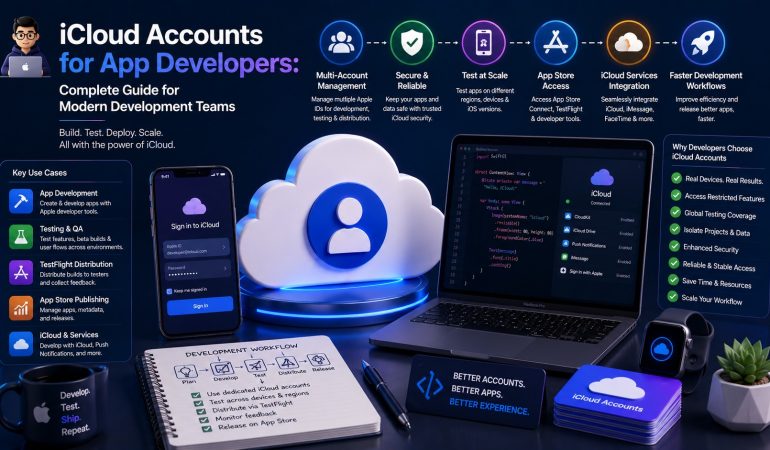
Building applications within Apple’s ecosystem requires far more than writing code. Many teams use iCloud accounts for app developers to streamline testing and development workflows.
Modern developers must manage testing environments, device compatibility checks, cloud synchronization, beta deployments, user validation scenarios, and ongoing application maintenance.
As projects grow, account management becomes an increasingly important part of the development workflow.
This is why many teams rely on iCloud accounts for app developers when building, testing, and maintaining applications across Apple’s ecosystem.
🚀 What You’ll Learn In This Guide
- ✅ Why developers use multiple iCloud accounts
- ✅ App testing workflows
- ✅ Device validation environments
- ✅ Team development operations
- ✅ QA and debugging processes
- ✅ Multi-device synchronization testing
- ✅ Security best practices
- ✅ Scaling development teams
- ✅ Future trends in Apple ecosystem development
According to Apple Developer, modern Apple applications increasingly depend on cloud-connected services, account authentication systems, device synchronization, and integrated ecosystem experiences.
As development operations expand, many teams utilize verified iCloud accounts to help support testing, deployment, and environment management workflows.
📑 Table of Contents
- 👨💻 Why Developers Use Multiple iCloud Accounts
- ⚙️ Development Workflow Requirements
- 🧪 Testing Environment Management
- ☁️ iCloud Features Developers Commonly Test
- 📱 Multi-Device Validation
- 👥 Team Development Operations
- 🔐 Security Considerations
- 🚀 Future Development Trends
- ❓ FAQ
- 🏁 Conclusion
👨💻 Why Developers Use Multiple iCloud Accounts
Many people assume a single account is sufficient for application development.
In reality, professional development teams frequently require multiple environments to accurately test different user scenarios.
Applications rarely operate under a single account condition.
Developers must evaluate how applications behave across numerous user states, devices, and synchronization environments.
📊 Common Developer Use Cases
| Development Task | Purpose |
|---|---|
| Authentication Testing | User login validation |
| Sync Testing | Cloud synchronization checks |
| Device Validation | Cross-device compatibility |
| QA Workflows | Bug identification |
| Beta Testing | Pre-release validation |
| Environment Separation | Controlled testing |
Development teams often separate testing environments to reduce operational conflicts and improve debugging accuracy.
🎯 Key Benefits for Developers
- 🧪 Isolated testing environments
- 📱 Device-specific validation
- ☁️ Synchronization testing
- 🔄 Repeatable workflows
- 👥 Team collaboration
- 📊 Better QA coverage
⚙️ Development Workflow Requirements
Modern application development is highly structured.
Most organizations divide work into multiple stages, each requiring its own testing and validation procedures.
📊 Typical Development Lifecycle
| Phase | Primary Objective |
|---|---|
| Planning | Requirements definition |
| Development | Feature creation |
| Testing | Validation |
| QA | Issue detection |
| Deployment | Release preparation |
| Maintenance | Ongoing improvements |
Many engineering teams follow methodologies promoted by platforms such as Atlassian Agile and Scrum Guide to improve software delivery efficiency.
The larger a project becomes, the more valuable structured testing environments become. Development teams that maintain organized account infrastructures generally achieve better testing consistency.
🧪 Testing Environment Management
Testing environments are one of the most important aspects of software development.
Applications must be validated under numerous conditions before deployment.
A properly designed testing framework helps identify issues before they affect users.
📋 Typical Testing Environments
- 🔧 Development environment
- 🧪 QA environment
- 📱 Device testing environment
- 🚀 Pre-production environment
- 📊 Beta testing environment
- 🌎 Production simulation environment
📊 Environment Comparison
| Environment | Primary Goal |
|---|---|
| Development | Feature creation |
| QA | Issue discovery |
| Staging | Release preparation |
| Beta | User validation |
| Production | Live operation |
Organizations implementing mature development practices often align testing frameworks with recommendations from OWASP and ISO quality management standards.
Development teams frequently evaluate verified iCloud accounts, developer iCloud accounts, and bulk iCloud accounts when establishing scalable testing infrastructures.
☁️ iCloud Features Developers Commonly Test
Applications integrated with Apple’s ecosystem often interact with various cloud-based services.
Developers must verify that these services behave consistently across devices and user environments.
📊 Common iCloud Testing Areas
| Feature | Testing Objective |
|---|---|
| Authentication | Login validation |
| Synchronization | Data consistency |
| Storage Access | File management |
| Account Switching | User state testing |
| Device Integration | Cross-device functionality |
| Backup Operations | Data recovery testing |
Technical documentation from Apple iCloud Developer Resources outlines numerous cloud-related capabilities available to application developers.
📱 Multi-Device Validation and Compatibility Testing
One of the biggest challenges in Apple ecosystem development involves ensuring consistent performance across multiple devices.
An application may function correctly on one device while exhibiting issues on another.
This makes device validation a critical component of development operations.
📋 Device Categories Commonly Tested
- 📱 iPhone
- 💻 Mac
- 📲 iPad
- ⌚ Apple Watch
- 📺 Apple TV
📊 Validation Areas
| Area | Importance |
|---|---|
| User Authentication | ⭐⭐⭐⭐⭐ |
| Synchronization | ⭐⭐⭐⭐⭐ |
| Data Integrity | ⭐⭐⭐⭐⭐ |
| UI Consistency | ⭐⭐⭐⭐ |
| Performance | ⭐⭐⭐⭐ |
👥 Team Development Operations and Account Management
As software projects grow, development becomes a team effort rather than an individual activity.
Modern applications often involve frontend developers, backend engineers, QA specialists, DevOps engineers, project managers, security teams, and product owners working together.
For this reason, iCloud accounts for app developers are often incorporated into structured development workflows that support collaboration and testing.
A solo developer may only need a few testing accounts, while a large software company may manage hundreds of accounts across multiple projects and testing environments.
📊 Development Team Structure
| Role | Primary Responsibility |
|---|---|
| Frontend Developer | User interface development |
| Backend Engineer | Server-side functionality |
| QA Tester | Quality assurance |
| DevOps Engineer | Deployment workflows |
| Security Engineer | Risk management |
| Product Manager | Project coordination |
🎯 Benefits of Organized Account Infrastructure
- 📱 Easier device testing
- 🔄 Repeatable workflows
- 🧪 Better QA coverage
- 👥 Improved collaboration
- 📊 Stronger documentation
- ⚙️ Simplified deployment preparation
Development organizations frequently use platforms such as Jira, Confluence, and Slack to coordinate development activities across teams.
🚀 CI/CD Workflows and Testing Automation
Modern development increasingly relies on Continuous Integration and Continuous Deployment (CI/CD).
These methodologies allow teams to ship software faster while maintaining quality standards.
Testing environments must support automated validation processes that identify issues before release.
📋 Typical CI/CD Pipeline Stages
- 📝 Code Commit
- 🔍 Code Review
- ⚙️ Build Process
- 🧪 Automated Testing
- 📊 Quality Validation
- 🚀 Deployment Preparation
- 🌎 Release Distribution
📊 CI/CD Benefits for Development Teams
| Benefit | Impact |
|---|---|
| Faster Releases | High |
| Reduced Errors | High |
| Improved Quality | High |
| Better Testing Coverage | High |
| Operational Efficiency | Very High |
Industry-leading CI/CD platforms such as GitHub Actions, GitLab, and Jenkins have transformed how development teams manage release cycles.
🧪 QA Testing and Bug Validation Workflows
Quality Assurance is one of the most resource-intensive stages of application development.
A single defect can negatively impact user experience, customer retention, reviews, and overall product reputation.
As a result, QA teams frequently create diverse testing environments to maximize coverage.
📋 Common QA Testing Categories
- 🐞 Bug validation
- 📱 Device compatibility testing
- ☁️ Cloud synchronization testing
- 🔐 Authentication testing
- ⚡ Performance testing
- 📊 Regression testing
📊 QA Priority Matrix
| Testing Area | Priority |
|---|---|
| Authentication | ⭐⭐⭐⭐⭐ |
| Data Integrity | ⭐⭐⭐⭐⭐ |
| Synchronization | ⭐⭐⭐⭐⭐ |
| Performance | ⭐⭐⭐⭐ |
| User Interface | ⭐⭐⭐⭐ |
| Accessibility | ⭐⭐⭐⭐ |
Organizations frequently align testing strategies with recommendations from ISTQB, one of the most widely recognized software testing standards organizations.
🐞 Debugging Complex User Scenarios
One of the biggest challenges developers face is reproducing real-world user behavior.
Applications often encounter issues that only appear under specific account conditions, device combinations, or synchronization states.
This makes scenario-based testing incredibly valuable.
📊 Common Debugging Scenarios
| Scenario | Testing Goal |
|---|---|
| New User | Onboarding validation |
| Returning User | Session continuity |
| Multi-Device User | Synchronization testing |
| Heavy Usage User | Performance validation |
| Offline User | Recovery testing |
💡 Developer Best PracticeApplications should always be tested under multiple user conditions rather than relying solely on ideal scenarios.
Teams frequently leverage verified iCloud accounts, developer iCloud accounts, testing iCloud accounts, and bulk iCloud accounts to support structured testing frameworks.
📱 Cross-Platform Apple Ecosystem Testing
Today’s Apple ecosystem extends far beyond the iPhone.
Applications often interact with multiple device categories simultaneously.
📊 Apple Ecosystem Testing Matrix
| Platform | Common Validation Areas |
|---|---|
| iPhone | Core functionality |
| iPad | Layout responsiveness |
| Mac | Desktop experience |
| Apple Watch | Companion interactions |
| Apple TV | Media experiences |
🎯 Why Ecosystem Testing Matters
- 📱 Device consistency
- ☁️ Cloud synchronization
- 👥 User experience continuity
- ⚡ Performance validation
- 🔄 Data integrity
- 📊 Product quality improvement
Technical guidance published through Apple Human Interface Guidelines encourages developers to deliver consistent experiences across Apple platforms.
🔐 Security Best Practices for Development Teams
Security should never be treated as an afterthought.
Development environments often contain sensitive source code, application data, testing assets, and business information.
🛡️ Security Checklist
- 🔐 Strong authentication
- 📋 Access management
- 👥 Role-based permissions
- 📊 Audit procedures
- 📝 Documentation standards
- 🚨 Incident response planning
📊 Security Priority Framework
| Area | Priority Level |
|---|---|
| Authentication | Critical |
| Account Recovery | Critical |
| Access Control | Critical |
| Documentation | High |
| Monitoring | High |
Recommendations from CISA, NIST, and OWASP consistently emphasize identity security and access management as critical software development practices.
🏢 Scaling Development Infrastructure
As applications grow, development infrastructure must evolve accordingly.
Small teams often transition into larger organizations with more complex testing and deployment requirements.
📊 Development Growth Stages
| Stage | Infrastructure Complexity |
|---|---|
| Solo Developer | Low |
| Startup Team | Moderate |
| Growing Company | High |
| Enterprise Team | Very High |
🚀 Advanced Developer Use Cases for iCloud Accounts
As development teams mature, their requirements extend far beyond basic application testing.
Large-scale projects often involve multiple environments, diverse user scenarios, automated validation systems, cloud-connected services, and distributed engineering teams.
This is where iCloud accounts for app developers become increasingly valuable within structured development operations.
The goal is not simply testing an app. The goal is validating how the app behaves under hundreds of realistic user conditions before release.
📊 Advanced Development Applications
| Use Case | Development Objective |
|---|---|
| User State Testing | Authentication validation |
| Cloud Sync Validation | Data consistency |
| Multi-Device Scenarios | Cross-platform reliability |
| QA Automation | Faster testing cycles |
| Regression Testing | Feature stability |
| Beta Program Testing | User feedback collection |
Engineering organizations frequently integrate cloud-based workflows with platforms such as Firebase, Amazon Web Services, and Microsoft Azure to support large-scale development operations.
📊 Creating a Professional Apple Testing Infrastructure
Successful software teams rarely rely on improvised testing procedures.
Instead, they establish repeatable systems that improve reliability and reduce deployment risks.
A structured testing infrastructure allows developers to validate applications efficiently throughout the development lifecycle.
📋 Core Infrastructure Components
- 📱 Device testing environments
- ☁️ Cloud validation workflows
- 🧪 QA testing systems
- 📊 Reporting dashboards
- 🔐 Security controls
- ⚙️ Deployment automation
📊 Development Infrastructure Maturity Model
| Maturity Level | Characteristics |
|---|---|
| Basic | Manual testing |
| Growing | Partial automation |
| Structured | Documented workflows |
| Advanced | Automated validation |
| Enterprise | Fully integrated systems |
Development organizations frequently deploy verified iCloud accounts, developer iCloud accounts, testing iCloud accounts, and bulk iCloud accounts when building scalable testing environments.
🌎 Supporting Distributed Development Teams
Software development is increasingly global.
Engineering teams often operate across multiple countries and time zones.
This creates additional challenges around collaboration, testing consistency, asset management, and environment synchronization.
📋 Common Remote Development Challenges
- 📂 Environment consistency
- 👥 Team coordination
- 📱 Device accessibility
- ☁️ Cloud validation
- 📊 Documentation management
- ⚡ Deployment efficiency
📊 Remote Team Success Factors
| Factor | Impact on Development |
|---|---|
| Documentation | High |
| Testing Standards | High |
| Communication | High |
| Automation | Very High |
| Security Controls | Very High |
Research from Gartner continues to show that structured digital collaboration systems significantly improve distributed engineering productivity.
⚠️ Common Mistakes Developers Make When Managing iCloud Testing Environments
Even experienced developers can introduce unnecessary complexity into testing workflows.
Many issues arise not because of coding mistakes, but because of poor testing environment management.
🚨 Frequent Development Mistakes
| Mistake | Potential Impact |
|---|---|
| Mixing Test Environments | Validation errors |
| Poor Documentation | Team confusion |
| Weak Security Controls | Operational risks |
| Limited Device Coverage | Missed bugs |
| Inconsistent Testing Standards | Reduced reliability |
| Manual Processes Only | Slower releases |
✅ Better Alternatives
- 📋 Establish testing standards
- 📝 Maintain documentation
- 🔐 Apply security controls
- ⚙️ Automate repetitive tasks
- 📱 Expand device coverage
- 📊 Audit testing procedures regularly
Quality management frameworks promoted by ISO emphasize consistency, documentation, and repeatable operational processes.
💰 How Better Testing Infrastructure Reduces Development Costs
Many organizations view testing infrastructure as a cost center.
In reality, poor testing practices are often far more expensive.
Undetected bugs, failed releases, emergency fixes, and user-facing issues can dramatically increase development costs.
📊 Cost Impact Analysis
| Issue | Potential Business Impact |
|---|---|
| Late Bug Discovery | High cost |
| Release Delays | Revenue impact |
| Customer Complaints | Brand damage |
| Emergency Patches | Engineering overhead |
| App Store Review Issues | Deployment delays |
📈 Engineering InsightThe earlier a problem is discovered, the cheaper it is to fix. This is one of the core principles behind modern software quality assurance.
Development teams that invest in structured testing workflows, quality assurance procedures, and verified iCloud accounts often achieve faster release cycles and higher software quality.
🔮 Future Trends for Apple Ecosystem Developers
The Apple ecosystem continues evolving rapidly.
Developers must adapt to changing user expectations, new device categories, and increasingly sophisticated cloud-based experiences.
🚀 Emerging Development Trends
- 🤖 AI-assisted software development
- ⚙️ Expanded automation pipelines
- ☁️ Cloud-native application design
- 📱 Cross-device experiences
- 🔐 Advanced identity management
- 📊 Real-time quality monitoring
📊 Future Technology Impact
| Technology | Expected Impact |
|---|---|
| Artificial Intelligence | Very High |
| Automation Platforms | Very High |
| Cloud Infrastructure | Very High |
| Identity Systems | High |
| Device Ecosystems | High |
Industry forecasts from Forrester, McKinsey & Company, and Deloitte continue to highlight automation, cloud computing, and digital transformation as major drivers of software innovation.
App developers rely on iCloud accounts throughout the development lifecycle, from testing to deployment and maintenance. For broader development workflows, see iCloud Accounts for Developers. Teams responsible for validation should also explore iCloud Accounts for QA Testing.
❓ Frequently Asked Questions
❓ Why do developers use multiple iCloud accounts?
Developers often need separate testing environments, user scenarios, device validation workflows, and cloud synchronization tests to ensure application reliability.
❓ How do iCloud accounts help app testing?
They can support authentication testing, synchronization validation, multi-device testing, and various user-state scenarios.
❓ Are iCloud accounts useful for QA teams?
Yes. QA teams frequently use structured testing environments to improve bug detection and software quality assurance.
❓ Why is cloud synchronization testing important?
Many modern applications rely on cloud-connected services, making synchronization accuracy critical for user experience.
❓ How do development teams improve testing coverage?
By combining multiple environments, automation systems, device testing, documentation, and repeatable validation processes.
❓ What are the biggest testing environment mistakes?
Mixing environments, weak documentation, inconsistent standards, poor security controls, and insufficient device coverage are among the most common issues.
❓ How can developers improve account security?
Implement strong authentication, maintain clear access controls, audit permissions regularly, and document account ownership.
❓ Where can development teams find scalable account resources?
Many organizations evaluate verified iCloud accounts, developer iCloud accounts, testing iCloud accounts, bulk iCloud accounts, and Apple testing infrastructure accounts when expanding development operations.
✅ Key Takeaways
- 👨💻 iCloud accounts for app developers support structured testing workflows.
- 🧪 Testing environments are critical for software quality.
- 📱 Multi-device validation improves user experience.
- ☁️ Cloud synchronization testing is increasingly important.
- 👥 Team collaboration benefits from organized account infrastructure.
- ⚙️ CI/CD workflows improve development efficiency.
- 🔐 Security remains a critical operational priority.
- 📊 Documentation strengthens consistency.
- 🚀 Automation helps accelerate release cycles.
- 🔮 Future development will become increasingly cloud-driven and automated.
🏆 Modern Development Success FormulaTesting + Automation + Security + Documentation + Scalability = High-Quality Apple Ecosystem Applications.
🏁 Conclusion
Building applications within Apple’s ecosystem requires much more than coding. Developers must manage testing environments, cloud integrations, device compatibility, quality assurance workflows, deployment pipelines, and ongoing maintenance.
This is why iCloud accounts for app developers have become an important component of modern development operations.
Whether supporting authentication testing, synchronization validation, multi-device workflows, QA procedures, or enterprise-scale development environments, properly managed account infrastructures help teams improve efficiency and software quality.
Organizations that leverage verified iCloud accounts, deploy developer iCloud accounts, utilize testing iCloud accounts, implement bulk iCloud accounts, and establish Apple testing infrastructure accounts are often better equipped to scale development operations efficiently.
As Apple technologies continue evolving, development teams that prioritize testing, automation, security, and operational excellence will be best positioned to deliver reliable, high-quality applications to users worldwide.