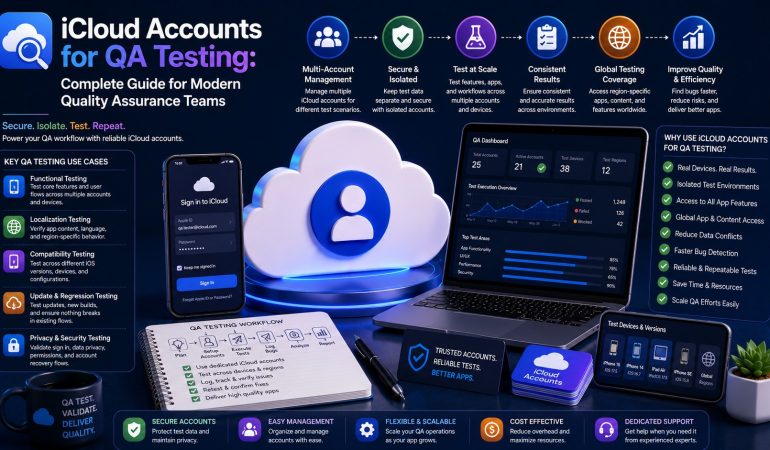
Quality Assurance is where software quality is either validated or exposed. As testing requirements grow, iCloud accounts for QA testing help teams manage authentication, synchronization, and multi-device validation more efficiently.
No matter how talented a development team may be, applications must undergo extensive testing before reaching end users.
Today’s Apple ecosystem is more connected than ever, requiring testers to validate user authentication, device synchronization, account switching, cloud storage interactions, backup functionality, and multi-device experiences.
This is exactly why iCloud accounts for QA testing have become a valuable resource for software companies, testing teams, mobile app developers, digital agencies, SaaS businesses, and enterprise organizations.
🎯 In This Guide You’ll Learn
- ✅ Why QA teams use multiple iCloud accounts
- ✅ Common Apple ecosystem testing scenarios
- ✅ User account validation workflows
- ✅ Cloud synchronization testing strategies
- ✅ Multi-device testing environments
- ✅ QA automation opportunities
- ✅ Team-based testing infrastructure
- ✅ Security and compliance considerations
- ✅ Future trends in Apple ecosystem QA
According to Apple Developer Testing Resources, comprehensive testing remains one of the most important stages of the software development lifecycle.
As applications become increasingly cloud-connected, QA teams often require multiple testing environments and user states to validate software behavior accurately.
Many organizations therefore utilize bulk iCloud accounts to support scalable testing operations across different devices, teams, and development environments.
📑 Table of Contents
- 🎯 Why QA Testing Requires Multiple iCloud Accounts
- ⚙️ Understanding the QA Testing Workflow
- 🧪 Common Testing Scenarios
- ☁️ iCloud Features QA Teams Commonly Test
- 📱 Multi-Device Validation
- 👥 QA Team Operations
- 🤖 Test Automation Opportunities
- 🔐 Security Best Practices
- ❓ FAQ
- 🏁 Conclusion
🎯 Why QA Testing Requires Multiple iCloud Accounts
One of the biggest misconceptions in software testing is that a single account can accurately represent all user behaviors.
Real users interact with applications differently.
Some are new users.
Others are returning users.
Some own multiple Apple devices while others use only one.
Many applications behave differently depending on account history, synchronization status, cloud data, or authentication states.
QA teams must therefore validate applications across numerous conditions.
📊 Why Multiple Testing Accounts Matter
| Testing Goal | Reason |
|---|---|
| User Authentication | Validate login flows |
| Account Switching | Verify session handling |
| Cloud Sync | Test data consistency |
| Device Migration | Validate transitions |
| Data Recovery | Test restoration scenarios |
| User Lifecycle | Validate account states |
🚀 Benefits for QA Teams
- 🧪 Better test coverage
- 📱 More realistic user simulations
- ☁️ Improved cloud testing
- 🐞 Faster bug discovery
- 📊 Better release confidence
- ⚙️ Repeatable testing procedures
⚙️ Understanding the QA Testing Workflow
Modern QA is far more sophisticated than manually tapping through an application.
Today’s testing teams follow structured workflows designed to identify defects before software reaches production.
📋 Typical QA Lifecycle
- 📌 Requirement Analysis
- 📝 Test Planning
- 🧪 Test Case Creation
- 📱 Environment Preparation
- 🐞 Test Execution
- 📊 Bug Reporting
- ✅ Verification
- 🚀 Release Validation
📊 QA Process Overview
| Phase | Primary Objective |
|---|---|
| Planning | Define scope |
| Preparation | Configure environments |
| Execution | Run tests |
| Reporting | Document issues |
| Validation | Confirm fixes |
| Release Review | Final approval |
Many QA departments follow frameworks promoted by ISTQB, one of the most widely recognized software testing organizations globally.
💡 QA Team InsightThe goal of testing is not proving that software works. The goal is discovering how and where it might fail before users encounter those problems.
🧪 Common Testing Scenarios in Apple Ecosystems
Applications integrated with Apple’s services often require specialized testing approaches.
QA teams must validate not only application functionality but also account-related behaviors.
📊 Frequently Tested Scenarios
| Scenario | QA Objective |
|---|---|
| New User Registration | Onboarding validation |
| Returning User Login | Session management |
| Password Changes | Account security testing |
| Device Replacement | Migration testing |
| Cloud Synchronization | Data consistency validation |
| Account Recovery | User continuity testing |
🎯 Real-World QA Example
Imagine a note-taking application that synchronizes content across iPhone, iPad, and Mac devices.
QA testers must verify:
- 📱 Notes appear correctly on all devices
- ☁️ Synchronization occurs properly
- 🔄 Changes update in real time
- 📂 Deleted data behaves correctly
- 📊 User sessions remain stable
- ⚡ Performance remains consistent
Resources from Apple Developer Documentation help QA teams understand expected platform behaviors.
☁️ iCloud Features QA Teams Commonly Test
Many Apple ecosystem applications rely heavily on cloud functionality.
Testing these services accurately often requires dedicated environments and multiple account states.
📊 Common iCloud Testing Areas
| Feature | QA Focus |
|---|---|
| Authentication | User access validation |
| Cloud Storage | File handling |
| Synchronization | Data consistency |
| Backup Processes | Recovery validation |
| Account Switching | Session testing |
| Device Integration | Cross-platform behavior |
Apple’s official iCloud Developer Resources provide technical guidance for cloud-enabled applications and services.
📱 Multi-Device Validation and Compatibility Testing
One of the biggest challenges facing QA teams is ensuring software performs consistently across Apple’s expanding ecosystem.
An issue may appear on one device but not another.
As a result, device validation has become a critical component of modern QA strategies.
📋 Common Device Categories
- 📱 iPhone
- 📲 iPad
- 💻 Mac
- ⌚ Apple Watch
- 📺 Apple TV
📊 Validation Priorities
| Area | Importance |
|---|---|
| User Authentication | ⭐⭐⭐⭐⭐ |
| Cloud Sync | ⭐⭐⭐⭐⭐ |
| Data Integrity | ⭐⭐⭐⭐⭐ |
| User Interface | ⭐⭐⭐⭐ |
| Performance | ⭐⭐⭐⭐ |
QA teams often deploy bulk iCloud accounts, QA testing iCloud accounts, developer iCloud accounts, and verified iCloud accounts to support large-scale testing infrastructure.
👥 QA Team Operations and Testing Environment Management
As software products become more sophisticated, quality assurance teams must manage increasingly complex testing infrastructures.
Modern applications often support thousands or even millions of users across multiple devices, operating systems, and cloud-connected services.
To maintain software quality, QA teams require structured environments that allow them to reproduce real-world scenarios consistently.
The more accurately a testing environment reflects real user behavior, the more valuable the testing results become.
📊 QA Team Responsibilities
| Role | Primary Focus |
|---|---|
| QA Analyst | Test execution |
| Automation Engineer | Automated validation |
| QA Lead | Strategy and planning |
| Performance Tester | Load and stress testing |
| Security Tester | Risk identification |
| Release Manager | Deployment readiness |
Organizations frequently coordinate testing activities using platforms such as Jira, TestRail, and Azure DevOps.
🎯 Benefits of Structured Testing Environments
- 📋 Better test organization
- 🧪 Repeatable test execution
- 📊 Improved reporting accuracy
- 🐞 Faster bug identification
- 👥 Enhanced team collaboration
- ⚙️ Easier scalability
🐞 Bug Validation and Defect Reproduction Workflows
Finding bugs is only the beginning of quality assurance.
QA teams must also reproduce issues consistently so developers can diagnose and resolve them effectively.
This often requires multiple user states, device configurations, and account environments.
📋 Typical Bug Validation Process
- 🔍 Identify issue
- 📝 Document reproduction steps
- 📱 Validate across devices
- ☁️ Verify cloud interactions
- 📊 Assess severity
- 🐞 Submit defect report
- ✅ Confirm resolution
📊 Defect Severity Matrix
| Severity Level | Business Impact |
|---|---|
| Critical | Application unusable |
| High | Major functionality affected |
| Medium | Partial feature issues |
| Low | Minor defects |
💡 QA Best PracticeA bug that cannot be reproduced consistently is significantly harder to fix. Detailed testing environments help reduce ambiguity during investigations.
🔄 Regression Testing in Apple Ecosystems
Every software update introduces the possibility of unintended side effects.
A feature that worked perfectly yesterday may fail after today’s code changes.
This is why regression testing remains one of the most critical QA responsibilities.
📊 Areas Commonly Included in Regression Testing
| Feature Area | Testing Objective |
|---|---|
| User Authentication | Access validation |
| Cloud Sync | Data integrity |
| User Profiles | Account consistency |
| Notifications | Delivery validation |
| Settings | Configuration testing |
| Data Storage | Persistence verification |
🚀 Why Regression Testing Matters
- 🐞 Prevents recurring defects
- 📊 Protects software quality
- ⚙️ Improves release confidence
- 📱 Validates ecosystem compatibility
- ☁️ Maintains cloud functionality
- 👥 Reduces customer-facing issues
Many software companies align testing methodologies with recommendations from ISTQB and quality management frameworks from ISO.
🤖 QA Automation and Scalable Testing
Manual testing remains important, but modern software often requires automation to achieve sufficient coverage.
Applications are updated frequently, making repetitive manual validation increasingly inefficient.
Automation helps teams test faster while improving consistency.
📋 Common Automation Use Cases
- 🔄 Regression testing
- 📱 Device validation
- ☁️ Cloud synchronization checks
- 🔐 Authentication workflows
- 📊 Performance validation
- ⚙️ Release readiness testing
📊 Automation Benefits
| Benefit | Impact |
|---|---|
| Faster Execution | Very High |
| Repeatability | Very High |
| Scalability | High |
| Error Reduction | High |
| Coverage Expansion | High |
Automation frameworks such as Selenium, Appium, and Playwright have become essential tools for modern QA teams.
📱 User Journey Testing and Real-World Validation
Applications are ultimately designed for people, not test cases.
As a result, QA teams increasingly focus on user journey testing to evaluate software from an end-user perspective.
📊 Common User Journey Scenarios
| User Scenario | Validation Goal |
|---|---|
| New User | Onboarding success |
| Returning User | Session continuity |
| Multi-Device User | Sync consistency |
| Power User | Performance validation |
| Offline User | Recovery behavior |
🎯 Key Validation Areas
- 📱 Device switching
- ☁️ Data synchronization
- 🔐 Account authentication
- 📂 Data recovery
- ⚡ Performance consistency
- 📊 User experience quality
Design recommendations from Apple Human Interface Guidelines emphasize creating seamless user experiences across the Apple ecosystem.
☁️ Cloud Synchronization Testing Strategies
Cloud-connected applications often present unique challenges for QA teams.
Data must remain accurate, synchronized, and accessible across multiple devices and user sessions.
Even small synchronization issues can negatively impact user trust.
📊 Synchronization Testing Matrix
| Scenario | Validation Objective |
|---|---|
| Real-Time Updates | Immediate sync validation |
| Device Changes | Data consistency |
| Offline Usage | Recovery verification |
| Concurrent Sessions | Conflict detection |
| Backup Recovery | Data restoration |
Technical resources available through CloudKit Documentation help development and QA teams better understand cloud synchronization behavior.
Many cloud-related bugs only appear under specific conditions such as poor connectivity, simultaneous device usage, or account transitions. These scenarios should always be included in QA plans.
🏢 Enterprise QA Infrastructure and Scaling
As organizations grow, testing requirements increase significantly.
A startup may only test a handful of user scenarios, while enterprise companies often validate thousands of combinations involving devices, operating systems, account states, and application versions.
📊 QA Infrastructure Growth Model
| Organization Size | Testing Complexity |
|---|---|
| Startup | Low |
| Small Team | Moderate |
| Mid-Sized Company | High |
| Enterprise | Very High |
To support larger testing operations, organizations often deploy bulk iCloud accounts, QA testing iCloud accounts, enterprise iCloud accounts, verified iCloud accounts, and testing environment iCloud accounts.
🚀 Advanced QA Methodologies for Apple Ecosystem Applications
As software systems become increasingly interconnected, traditional testing approaches are no longer sufficient.
Modern QA teams must validate applications across numerous devices, account states, operating system versions, network conditions, and cloud environments.
This is why iCloud accounts for QA testing are often incorporated into advanced testing frameworks that simulate realistic user behavior at scale.
Testing should reflect how real users interact with software, not how developers expect users to behave.
📊 Advanced QA Testing Approaches
| Methodology | Primary Objective |
|---|---|
| Exploratory Testing | Discover unexpected issues |
| Scenario Testing | Validate user journeys |
| Regression Testing | Prevent recurring defects |
| Compatibility Testing | Cross-device validation |
| Performance Testing | Assess responsiveness |
| Security Testing | Identify vulnerabilities |
Organizations with mature QA programs often combine several testing methodologies to maximize coverage and minimize release risks.
🔐 Security Testing and Account Validation
Security is no longer a specialized concern reserved only for cybersecurity teams.
Today’s QA departments frequently participate in validating authentication systems, account management processes, access controls, and data protection mechanisms.
🛡️ Security Testing Areas
- 🔐 Authentication workflows
- 👤 User access validation
- 📋 Session management
- ☁️ Cloud permissions testing
- 📱 Device authorization checks
- 🚨 Account recovery validation
📊 Security Testing Priorities
| Area | Priority Level |
|---|---|
| Authentication | Critical |
| Access Control | Critical |
| Session Handling | Critical |
| Data Protection | High |
| Recovery Processes | High |
Security guidance from OWASP, NIST, and CISA highlights the importance of identity validation and secure account management within modern applications.
⚠️ Common QA Mistakes When Testing Apple Applications
Even highly experienced QA teams can introduce blind spots into their testing processes.
Many software defects reach production not because testing was absent, but because testing coverage was incomplete.
🚨 Common Testing Mistakes
| Mistake | Potential Consequence |
|---|---|
| Testing Only Happy Paths | Missed edge cases |
| Ignoring Multi-Device Scenarios | Synchronization failures |
| Limited Account Coverage | User-state bugs |
| Poor Documentation | Reproduction difficulties |
| Skipping Regression Testing | Recurring defects |
| Insufficient Automation | Reduced scalability |
✅ Better QA Practices
- 📱 Test across multiple devices
- ☁️ Validate cloud interactions
- 🧪 Expand scenario coverage
- 📋 Maintain documentation
- ⚙️ Automate repetitive workflows
- 📊 Track quality metrics consistently
💡 QA Leadership InsightThe most dangerous defects are often those that were never included in the testing scope. Broad coverage reduces this risk significantly.
📊 Measuring QA Success
Testing activities should be measurable.
Without metrics, organizations struggle to determine whether software quality is improving or declining.
Modern QA teams rely heavily on performance indicators to evaluate effectiveness.
📋 Common QA Metrics
- 🐞 Defect discovery rate
- 📊 Test coverage percentage
- ⚡ Execution speed
- 🔄 Regression success rate
- 📱 Device coverage
- 🚀 Release readiness score
📊 QA KPI Framework
| Metric | Business Value |
|---|---|
| Defect Detection | Quality improvement |
| Automation Coverage | Efficiency gains |
| Release Stability | Customer satisfaction |
| Testing Speed | Faster delivery |
| Bug Resolution Time | Operational effectiveness |
Research published by Gartner and Forrester consistently demonstrates that organizations with mature quality assurance programs achieve better software delivery outcomes.
☁️ Building a Scalable QA Testing Infrastructure
As applications evolve, testing environments must scale accordingly.
A testing framework that supports ten users may not adequately support ten thousand.
Scalable QA infrastructure helps organizations maintain consistency as products grow.
📊 Infrastructure Components
| Component | Purpose |
|---|---|
| Test Accounts | User simulation |
| Device Pools | Compatibility testing |
| Automation Systems | Execution efficiency |
| Reporting Platforms | Quality visibility |
| Cloud Environments | Service validation |
| Documentation Repositories | Knowledge management |
🚀 Characteristics of Mature QA Teams
- 📋 Documented procedures
- 📊 Strong reporting systems
- ⚙️ Automated validation
- 👥 Clear ownership structures
- 🔐 Security integration
- 🧪 Continuous improvement processes
Many organizations support these environments using bulk iCloud accounts, QA testing iCloud accounts, enterprise iCloud accounts, verified iCloud accounts, Apple testing accounts, and scalable testing environments.
🔮 Future Trends in QA Testing
The software testing landscape continues evolving rapidly.
Artificial intelligence, automation, cloud-native development, and increasingly connected ecosystems are reshaping how QA teams operate.
🚀 Emerging Trends
- 🤖 AI-assisted testing
- ⚙️ Autonomous automation
- ☁️ Cloud-native QA workflows
- 📱 Expanded device ecosystems
- 📊 Real-time quality analytics
- 🔐 Security-first testing strategies
📊 Future Impact Assessment
| Trend | Expected Impact |
|---|---|
| Artificial Intelligence | Very High |
| Automation Expansion | Very High |
| Cloud Testing | Very High |
| Security Validation | High |
| Device Diversity | High |
Industry forecasts from McKinsey & Company, Deloitte, and Accenture suggest that automation and AI will become central pillars of future software quality assurance programs.
Quality assurance teams depend on realistic testing environments to identify issues before release. For application-focused testing workflows, review iCloud Accounts for App Testing. Teams validating hardware compatibility should also explore iCloud Accounts for Device Testing.
❓ Frequently Asked Questions
❓ Why are iCloud accounts for QA testing important?
They help QA teams simulate realistic user scenarios, validate cloud-connected features, test synchronization workflows, and improve software quality across Apple’s ecosystem.
❓ Why do QA teams use multiple accounts?
Different user states often reveal different behaviors. Multiple accounts allow testers to validate onboarding, authentication, synchronization, recovery, and account transition scenarios.
❓ What Apple ecosystem features require extensive testing?
Authentication, cloud synchronization, backups, storage interactions, account switching, and multi-device experiences are among the most frequently tested areas.
❓ How does QA automation improve testing?
Automation increases coverage, improves consistency, reduces repetitive work, and helps teams validate software faster.
❓ Why is cloud synchronization testing critical?
Many modern applications rely heavily on cloud services. Synchronization failures can negatively affect user experience and data integrity.
❓ What is regression testing?
Regression testing ensures that new code changes do not break existing functionality.
❓ How can organizations scale QA operations?
By implementing automation, standardized workflows, structured testing environments, device pools, and scalable account infrastructures.
❓ Where can QA teams obtain testing resources?
Many organizations evaluate bulk iCloud accounts, QA testing iCloud accounts, enterprise iCloud accounts, verified iCloud accounts, and Apple testing accounts when expanding quality assurance infrastructure.
✅ Key Takeaways
- 🧪 iCloud accounts for QA testing help teams simulate realistic user conditions.
- 📱 Multi-device validation is critical within Apple’s ecosystem.
- ☁️ Cloud synchronization testing remains a top QA priority.
- 🐞 Structured defect reproduction improves development efficiency.
- ⚙️ Automation increases testing scalability.
- 📊 Metrics help organizations measure quality improvements.
- 🔐 Security testing should be integrated into QA workflows.
- 👥 Team collaboration benefits from organized testing environments.
- 🚀 Scalable infrastructure supports long-term growth.
- 🔮 AI and automation will continue transforming software testing.
🏆 QA Excellence FormulaCoverage + Consistency + Automation + Security + Scalability = High-Quality Software Releases.
🏁 Conclusion
Quality assurance plays a critical role in delivering reliable software experiences across Apple’s ecosystem.
As applications become increasingly cloud-connected and multi-device focused, testing environments must evolve accordingly.
This is why iCloud accounts for QA testing have become an important component of modern software validation strategies.
Whether supporting authentication workflows, synchronization testing, user journey validation, regression testing, security assessments, or enterprise-scale QA operations, structured account infrastructures help teams achieve broader coverage and greater confidence before release.
Organizations that utilize bulk iCloud accounts, deploy QA testing iCloud accounts, leverage enterprise iCloud accounts, implement verified iCloud accounts, and build scalable testing environments are often better positioned to deliver stable, reliable, and high-performing software.
Ultimately, effective QA is not about finding a few bugs. It is about building confidence that software will perform successfully for real users in real-world environments.