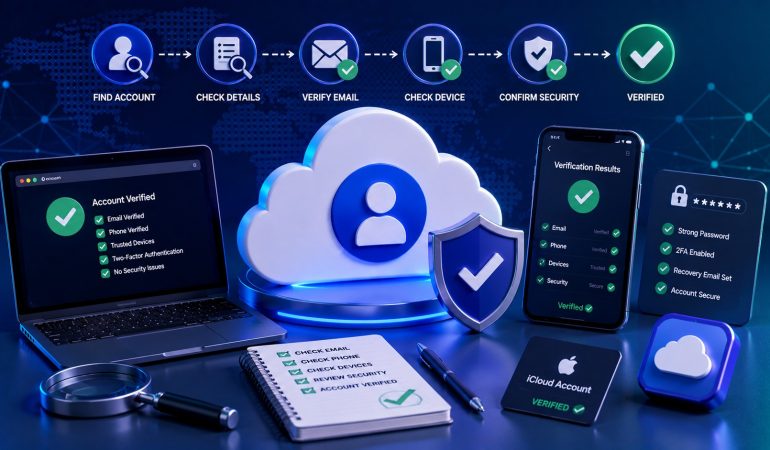
Not all iCloud accounts are created equal. Whether you’re a developer, software tester, business owner, marketer, or everyday Apple user, understanding how to verify iCloud account status is essential before relying on an account for important activities.
An account may appear functional at first glance, yet still contain issues that affect usability, security, recovery options, device compatibility, or long-term reliability.
That’s why experienced users perform a verification process before actively using any account.
Verification isn’t simply about confirming login access. It involves evaluating the account’s security configuration, recovery setup, authentication status, trust level, and operational readiness.
🚀 Quick Verification Overview
- ✅ Confirm login access
- ✅ Check Apple ID status
- ✅ Verify recovery information
- ✅ Review trusted devices
- ✅ Confirm security settings
- ✅ Check iCloud functionality
- ✅ Validate account ownership controls
According to Apple Support, your Apple ID serves as the primary authentication credential for Apple services, making account verification an important part of maintaining security and usability.
This guide explains how professionals evaluate account quality, what verification indicators matter most, common warning signs, and best practices for validating account readiness.
📑 Table of Contents
- 🔍 What Does a Verified iCloud Account Mean?
- ⚠️ Why Verification Matters
- ✅ Initial Verification Checks
- 🔐 Security Verification Process
- 📧 Recovery Information Validation
- ☁️ Testing Core iCloud Features
- 📊 Quality Indicators of a Verified Account
- 🚨 Verification Red Flags
- ❓ FAQ
- 🏁 Conclusion
🔍 What Does a Verified iCloud Account Mean?
Many people misunderstand the term “verified.”
A verified account is not simply an account that allows login access.
Instead, it generally refers to an account whose critical elements have been validated and confirmed.
📋 Typical Verification Areas
| Verification Area | Purpose |
|---|---|
| Login Status | Confirm access |
| Recovery Options | Account restoration |
| Security Settings | Protection assessment |
| Trusted Devices | Ownership validation |
| iCloud Services | Functionality confirmation |
| Authentication Status | Security verification |
Verification helps determine whether an account is ready for long-term use.
A working account is not necessarily a fully verified account. Verification requires evaluating multiple components, not just successful login access.
⚠️ Why Verification Matters Before Using an iCloud Account
Using an unverified account can create unexpected problems later.
Issues may not become visible until:
- 🔐 Password recovery is needed
- 📱 New devices are connected
- ☁️ iCloud synchronization begins
- 📧 Authentication challenges occur
- 🔄 Security settings require modification
📊 Risks of Poor Verification
| Issue | Potential Impact |
|---|---|
| Missing Recovery Access | Account lockout |
| Unknown Trusted Devices | Security concerns |
| Weak Security Settings | Unauthorized access risk |
| Unverified Information | Recovery complications |
| Improper Configuration | Operational problems |
Organizations managing multiple verified iCloud accounts often establish verification checklists before accounts enter production use.
✅ Step 1: Perform Initial Verification Checks
The first stage focuses on basic account accessibility and functionality.
📋 Initial Verification Checklist
- 🔑 Confirm login credentials work
- 📱 Verify Apple ID accessibility
- ☁️ Access iCloud dashboard
- 📧 Review account information
- 🔄 Confirm service availability
- 📍 Check region settings
📊 Initial Verification Matrix
| Check | Status |
|---|---|
| Successful Login | ☐ |
| Apple ID Accessible | ☐ |
| iCloud Functional | ☐ |
| Settings Accessible | ☐ |
| Security Menu Available | ☐ |
Apple provides account-management resources through Apple ID Management where many of these checks can be performed.
🔐 Step 2: Verify Security Configuration
Security validation is one of the most important stages of the verification process.
A secure account should have properly configured protection mechanisms.
🛡️ Security Components to Review
- 🔐 Password strength
- 📱 Two-Factor Authentication
- 👥 Trusted devices
- 📧 Recovery methods
- 🚨 Security alerts
- 🔄 Recent activity
📊 Security Assessment Table
| Security Element | Importance |
|---|---|
| Password Security | ⭐⭐⭐⭐⭐ |
| Two-Factor Authentication | ⭐⭐⭐⭐⭐ |
| Trusted Devices | ⭐⭐⭐⭐ |
| Recovery Information | ⭐⭐⭐⭐⭐ |
| Activity Monitoring | ⭐⭐⭐⭐ |
Apple strongly recommends enabling Two-Factor Authentication, as detailed in Apple’s 2FA documentation.
For organizations that maintain inventories of Apple ID accounts, standardized security verification procedures help reduce operational risks.
📧 Step 3: Validate Recovery Information
One of the most overlooked aspects of how to verify iCloud account status is recovery verification.
Many users only discover recovery problems when they are locked out of an account.
A properly verified account should have fully functional recovery methods configured and accessible.
If recovery options cannot be confirmed, the verification process should be considered incomplete regardless of whether login access currently works.
📋 Recovery Information Checklist
- 📧 Recovery email verified
- 📱 Recovery phone number active
- 🔐 Two-Factor Authentication functioning
- 👥 Trusted devices accessible
- ☁️ Account recovery settings reviewed
- 📝 Security information updated
📊 Recovery Verification Matrix
| Recovery Component | Status Check | Importance |
|---|---|---|
| Recovery Email | Verified | ⭐⭐⭐⭐⭐ |
| Phone Number | Active | ⭐⭐⭐⭐⭐ |
| Trusted Device | Accessible | ⭐⭐⭐⭐⭐ |
| 2FA Verification | Working | ⭐⭐⭐⭐⭐ |
| Recovery Settings | Configured | ⭐⭐⭐⭐ |
Apple provides detailed guidance through Apple Account Recovery resources that can help users understand recovery mechanisms and account restoration procedures.
☁️ Step 4: Test Core iCloud Features
Account verification should extend beyond authentication.
An account may log in successfully while still experiencing service-related limitations or configuration issues.
Testing key iCloud functions helps confirm operational readiness.
☁️ Core Services to Test
- 📂 iCloud Drive
- 📸 Photos
- 📧 iCloud Mail
- 📱 Device Synchronization
- 📝 Notes
- 📇 Contacts
- 📅 Calendar
📊 iCloud Service Validation Table
| Service | Verification Method |
|---|---|
| iCloud Drive | Upload & download file |
| Photos | Sync test image |
| Send & receive email | |
| Contacts | Create sync test |
| Calendar | Create test event |
| Notes | Cross-device sync |
Testing these services through iCloud.com helps verify whether cloud functionality is operating correctly.
📊 Key Indicators of a Fully Verified iCloud Account
Professionals often evaluate accounts using a quality-assessment framework.
Rather than relying on a single verification point, multiple indicators are examined together.
🏆 High-Quality Account Indicators
| Indicator | What It Suggests |
|---|---|
| Successful Login | Accessibility |
| Active Recovery Methods | Recoverability |
| 2FA Enabled | Security |
| Trusted Device Visibility | Ownership Control |
| Working iCloud Services | Operational Readiness |
| Updated Security Settings | Account Health |
📈 Account Verification Scorecard
| Score | Assessment |
|---|---|
| 90-100% | Excellent Verification Status |
| 75-89% | Good Verification Status |
| 60-74% | Requires Additional Checks |
| Below 60% | Verification Incomplete |
Businesses managing multiple verified iCloud accounts frequently use internal scoring systems to standardize account onboarding procedures.
📱 Verifying Trusted Devices and Device Associations
Trusted devices play a major role in account security and ownership validation.
Reviewing device associations helps identify unexpected access points.
🔍 What to Review
- 📱 Active iPhones
- 💻 Mac computers
- 📲 iPads
- ⌚ Apple Watches
- 📺 Apple TVs
📊 Device Verification Checklist
| Device Check | Status |
|---|---|
| Known Devices Only | ☐ |
| No Unknown Hardware | ☐ |
| Trusted Device List Updated | ☐ |
| Unused Devices Removed | ☐ |
Apple’s Trusted Devices documentation explains how device relationships affect authentication and account security.
🎯 Professional Verification TipWhenever possible, remove outdated devices before beginning long-term use of an account. This simplifies future security management and reduces confusion.
🔐 How to Verify Two-Factor Authentication Status
Two-Factor Authentication remains one of the strongest indicators of a properly secured account.
Verification should confirm not only whether 2FA exists but also whether it functions correctly.
📋 2FA Verification Process
- Open Apple ID settings
- Navigate to Security section
- Confirm Two-Factor Authentication status
- Review trusted devices
- Verify trusted phone numbers
- Test authentication workflow if appropriate
📊 Authentication Health Assessment
| Factor | Verification Goal |
|---|---|
| 2FA Enabled | Security Layer Present |
| Phone Number Active | Verification Capability |
| Trusted Device Available | Recovery Readiness |
| Authentication Working | Operational Security |
Security organizations such as CISA consistently recommend multi-factor authentication as one of the most effective protections against account compromise.
🚨 Red Flags That Suggest Verification Problems
Experienced users know what warning signs to watch for.
These indicators often reveal hidden account-management issues.
⚠️ Common Red Flags
| Red Flag | Risk Level |
|---|---|
| Missing Recovery Access | High |
| Unknown Trusted Devices | High |
| Disabled Security Features | High |
| Unverified Contact Information | Medium |
| Service Functionality Issues | Medium |
| Incomplete Settings Access | High |
Organizations performing large-scale account validation often quarantine accounts showing verification inconsistencies until issues are resolved.
🏢 Verification Procedures for Businesses and Teams
Businesses handling large account inventories benefit from standardized verification workflows.
Instead of evaluating accounts individually using inconsistent methods, organizations often establish repeatable verification frameworks.
📊 Business Verification Workflow
| Stage | Objective |
|---|---|
| Login Validation | Access Confirmation |
| Security Audit | Protection Assessment |
| Recovery Validation | Account Recoverability |
| Service Testing | Functionality Review |
| Documentation | Inventory Tracking |
Companies expanding operations often source verified iCloud accounts, maintain dedicated account inventories, and implement ongoing verification audits to ensure operational reliability.
🚀 Advanced Verification Techniques Used by Professionals
Once the basic checks have been completed, experienced users often move to a deeper verification process.
This stage focuses on determining whether an account is suitable for long-term use, business operations, testing environments, marketing workflows, or cloud-based activities.
When discussing how to verify iCloud account quality, advanced verification provides a much clearer picture than simply confirming login access.
The goal is not merely to confirm that an account works today. The goal is to determine whether it will remain secure, recoverable, and functional tomorrow.
📋 Advanced Verification Areas
- 🔐 Security configuration review
- ☁️ Service functionality testing
- 📱 Device association validation
- 📧 Recovery readiness assessment
- 📊 Account health evaluation
- 🔄 Synchronization testing
- 🛡️ Authentication verification
📊 Professional Verification Framework
| Verification Layer | Objective | Priority |
|---|---|---|
| Authentication | Access validation | ⭐⭐⭐⭐⭐ |
| Security | Protection review | ⭐⭐⭐⭐⭐ |
| Recovery | Recoverability testing | ⭐⭐⭐⭐⭐ |
| Services | Functionality validation | ⭐⭐⭐⭐ |
| Devices | Ownership confirmation | ⭐⭐⭐⭐ |
Organizations that rely heavily on Apple services often establish formal verification standards before accounts enter production environments.
📊 Creating an iCloud Account Audit System
One-time verification is useful, but ongoing auditing is even more valuable.
Many businesses, developers, and testing teams implement periodic reviews to ensure account quality remains consistent.
📋 Monthly Audit Checklist
| Audit Item | Frequency |
|---|---|
| Trusted Device Review | Monthly |
| Security Settings Check | Monthly |
| Password Assessment | Quarterly |
| Recovery Information Review | Quarterly |
| Service Testing | Monthly |
| Authentication Verification | Monthly |
Frameworks published by NIST and security recommendations from OWASP consistently emphasize continuous monitoring rather than one-time validation.
🏢 Verification Best Practices for Business Environments
Organizations managing dozens or even hundreds of accounts need repeatable procedures.
Without standardized verification workflows, inconsistencies can quickly appear.
🏆 Enterprise Verification Model
| Phase | Goal |
|---|---|
| Account Intake | Initial validation |
| Security Review | Protection assessment |
| Recovery Testing | Recoverability confirmation |
| Documentation | Inventory tracking |
| Periodic Auditing | Long-term quality assurance |
Businesses that manage large inventories of verified iCloud accounts often use centralized documentation systems to track account health, security status, and verification history.
📈 Benefits of Standardized Verification
- 📊 Better account visibility
- 🔐 Improved security
- 📱 Reduced device conflicts
- ⚡ Faster onboarding
- ☁️ More reliable operations
- 🚀 Easier scalability
☁️ How to Verify iCloud Synchronization Reliability
Synchronization functionality is one of the most important operational indicators.
An account may appear healthy while hidden sync issues create future problems.
📋 Sync Verification Process
- 📸 Upload a photo
- 📂 Create a file in iCloud Drive
- 📇 Add a contact
- 📝 Create a note
- 📅 Add a calendar event
- 📱 Verify synchronization across devices
📊 Synchronization Validation Table
| Service | Expected Result |
|---|---|
| Photos | Cross-device sync |
| Contacts | Near-real-time update |
| Notes | Consistent availability |
| Calendar | Device synchronization |
| iCloud Drive | File availability |
Apple’s official iCloud platform provides access to many of these services and can be used as part of the verification process.
🎯 Verification InsightAccounts that successfully pass synchronization testing generally demonstrate stronger operational readiness than accounts that are evaluated solely through login testing.
⚠️ Common Mistakes When Verifying an iCloud Account
Many users rush through verification and overlook critical indicators.
These mistakes can create future complications.
🚨 Most Common Verification Mistakes
| Mistake | Potential Consequence |
|---|---|
| Checking login only | Incomplete verification |
| Ignoring recovery options | Future lockouts |
| Skipping service testing | Hidden issues remain |
| Ignoring trusted devices | Security concerns |
| Not reviewing 2FA | Weak protection |
| Failing to document results | Operational confusion |
📋 What Experts Do Instead
- ✅ Verify access
- ✅ Verify security
- ✅ Verify recovery
- ✅ Verify services
- ✅ Verify devices
- ✅ Document outcomes
This structured approach helps ensure that verification produces meaningful results.
🔮 Future Trends in Account Verification
Account verification processes continue evolving alongside security technologies.
Future verification methods will likely place greater emphasis on identity assurance, device trust, and advanced authentication systems.
📈 Emerging Verification Trends
- 🔑 Passkey adoption
- 📱 Biometric authentication
- 🤖 AI-assisted security monitoring
- ☁️ Enhanced cloud validation
- 📊 Automated account auditing
- 🛡️ Behavioral verification systems
📊 Future Verification Technologies
| Technology | Expected Impact |
|---|---|
| Passkeys | Very High |
| Biometrics | High |
| AI Security Systems | High |
| Automated Audits | High |
| Behavior Analytics | Medium-High |
Industry initiatives led by the FIDO Alliance continue shaping the future of identity verification and authentication technologies.
❓ Frequently Asked Questions
What does a verified iCloud account mean?
A verified account generally refers to an account whose login access, security settings, recovery methods, and operational functionality have been properly validated.
How do I verify iCloud account security?
Review password security, Two-Factor Authentication status, trusted devices, recovery options, and recent account activity.
Is login access enough to verify an account?
No. Login access is only one component. Security, recovery, service functionality, and device associations should also be evaluated.
Why should recovery information be verified?
Recovery information helps restore access if authentication issues occur. Without verified recovery options, account management becomes more difficult.
How often should account verification be performed?
Individuals should review account settings periodically, while businesses often perform monthly or quarterly audits.
Why should trusted devices be reviewed?
Trusted devices can receive authentication requests and security notifications. Unknown devices may indicate security concerns.
Can iCloud services be tested during verification?
Yes. Testing Photos, Notes, Contacts, Calendar, Mail, and iCloud Drive helps confirm account functionality.
Where can organizations find reliable account solutions?
Organizations often evaluate verified iCloud accounts, Apple ID accounts, bulk iCloud accounts, and managed iCloud account solutions to support operational requirements.
Verifying account quality before purchase can prevent many common problems later. To understand why verification matters, see Phone Verified iCloud Accounts Explained. Buyers should also review Common Mistakes When Buying iCloud Accounts to avoid costly mistakes.
✅ Key Takeaways
- 🔍 Verifying an account involves much more than checking login access.
- 🔐 Security settings should be reviewed carefully.
- 📧 Recovery methods are critical verification components.
- 📱 Trusted devices help validate ownership and security.
- ☁️ Core iCloud services should be tested.
- 📊 Verification frameworks improve consistency.
- 🏢 Businesses benefit from standardized verification workflows.
- ⚠️ Ignoring recovery settings can create future risks.
- 🚀 Ongoing auditing improves long-term account quality.
- 🛡️ Comprehensive verification leads to better operational reliability.
🏆 Final Verification ChecklistBefore considering an iCloud account fully verified, confirm login access, review security settings, validate recovery information, inspect trusted devices, test cloud services, and document verification results.
🏁 Conclusion
Understanding how to verify iCloud account status is essential for anyone who depends on Apple services for personal, business, development, testing, or operational purposes.
A comprehensive verification process goes far beyond simply signing in. It involves evaluating authentication systems, security settings, recovery readiness, device relationships, synchronization functionality, and overall account health.
Organizations managing large inventories of verified iCloud accounts, maintaining Apple ID accounts, utilizing bulk iCloud accounts, or operating through managed iCloud account solutions can significantly benefit from structured verification and auditing procedures.
By following the best practices outlined in this guide, users can improve account reliability, strengthen security, reduce operational risks, and ensure that their iCloud accounts remain fully functional and ready for long-term use.