If you’ve ever tried to use iCloud accounts for app store research — checking competitor rankings, testing regional pricing, or auditing keyword performance — you’ve probably run into the same frustrating wall: your results are skewed. Apple’s App Store personalizes search rankings, recommendations, and even pricing based on your account history, region settings, and past download behavior. That means the data you’re pulling isn’t a clean signal — it’s filtered through your own account’s footprint.
🚀 Quick SummaryApp Store research — competitive audits, regional ASO testing, keyword ranking checks, and listing analysis — requires multiple isolated Apple IDs to produce accurate, unbiased data. This guide breaks down exactly how iCloud accounts for app store research fit into a researcher’s workflow, how to structure them by region or function, and how to avoid the data contamination that ruins most single-account research efforts.
This is the exact problem that iCloud accounts for app store research are built to solve. Researchers, ASO (App Store Optimization) specialists, product managers, and competitive analysts use dedicated, isolated Apple IDs — often called aged iCloud accounts — to pull clean, unbiased data that reflects what real users in a given region or segment actually see. 📱
In this guide, we’ll walk through why personalization breaks App Store research, how dedicated iCloud accounts fix that problem, the specific research workflows where this matters most, and how to structure a multi-account research setup that scales as your needs grow.
📋 Table of Contents
- Why Personalization Breaks App Store Research
- Core Use Cases for App Store Research
- Regional and Localization Research
- Competitive Analysis Workflows
- Structuring Research Accounts by Function
- Setup Best Practices
- Common Research Pitfalls to Avoid
- Frequently Asked Questions
- Key Takeaways
- Conclusion
🔍 Why Personalization Breaks App Store Research
Apple’s App Store algorithm doesn’t show every user the same thing. Search rankings, “You Might Also Like” recommendations, featured banners, and even pricing can shift based on:
- Your account’s region and billing country
- Previous download and purchase history
- Search history within the App Store app itself
- Device-level signals tied to your Apple ID
For casual users, this personalization is a feature. For researchers, it’s a liability. If you’re auditing where a competitor’s app ranks for a specific keyword, and you’re logged into an account that’s previously downloaded similar apps, you’re not seeing what a neutral user sees — you’re seeing a result shaped by your own account’s behavior.
This is precisely why dedicated, isolated iCloud accounts for app store research have become standard practice among ASO professionals and competitive intelligence teams. Each account stays untouched by unrelated activity, preserving the integrity of every check.
App Store research often requires multiple accounts for localization testing, competitor analysis, and market research. Developers can expand these workflows with iCloud Accounts for App Developers. Agencies conducting large-scale research projects should also explore iCloud Accounts for Digital Agencies.
🧪 Core Use Cases for App Store Research
App Store research isn’t one task — it’s a cluster of related but distinct activities, each benefiting from clean, dedicated accounts:
1. Keyword Ranking Verification
Confirming where your own app — or a competitor’s — actually ranks for a target keyword, without personalization skewing the result.
2. Listing and Creative Audits
Reviewing how competitor screenshots, app previews, descriptions, and icons are structured, often across multiple device sizes and OS versions.
3. Pricing and Monetization Research
Checking how in-app purchase pricing, subscription tiers, and promotional offers differ by region — something that’s invisible unless you’re logged in with an account actually registered to that region.
4. Review and Rating Pattern Analysis
Tracking how review velocity, rating distribution, and developer responses evolve over time for a given app or category.
| Research Task | Why a Dedicated Account Matters |
|---|---|
| Keyword Ranking Checks | Prevents personalized search results from masking true ranking position |
| Listing Audits | Ensures you see the same listing version as a new, unbiased user |
| Pricing Research | Region-locked accounts reveal accurate local pricing and promotions |
| Review Pattern Tracking | Keeps a clean historical record without cross-contamination from other research |
🌍 Regional and Localization Research
One of the most common reasons teams seek out iCloud accounts for app store research is regional testing. The App Store displays different content, pricing, and even app availability depending on the account’s registered country — not just the device’s location settings.
For teams researching international expansion or auditing how competitors approach different markets, this means a single account simply isn’t enough. You need region-specific accounts to answer questions like:
- How does a competitor’s app description differ between the US and UK App Store listings?
- Are subscription prices adjusted for purchasing power in different countries?
- Is a particular app even available in a target market, or geo-restricted?
- How do featured placements and editorial picks differ by region?
Apple’s own App Store localization guidelines confirm just how deeply region-specific the App Store experience is designed to be — which is exactly why single-account research produces such an incomplete picture.
Building a Regional Account Matrix
Teams serious about international ASO research often maintain a small matrix of accounts, each tied to a specific App Store storefront. This isn’t about having dozens of accounts for every country Apple supports — it’s about covering your priority markets with intention.
| Region | Common Research Focus | Account Priority |
|---|---|---|
| United States | Primary keyword benchmarking, competitor baseline | High |
| United Kingdom | Localization quality, pricing comparison | Medium-High |
| Germany / EU markets | GDPR-related app behavior, regional pricing | Medium |
| Southeast Asia | Emerging market positioning, app availability checks | Variable by industry |
📊 Competitive Analysis Workflows
Competitive analysis is arguably where dedicated iCloud accounts for app store research earn their keep the most. Product teams and marketers tracking competitor apps need consistent, repeatable observation points — not one-off snapshots taken from whatever account happens to be logged in that day.
Setting Up a Competitive Tracking Cadence
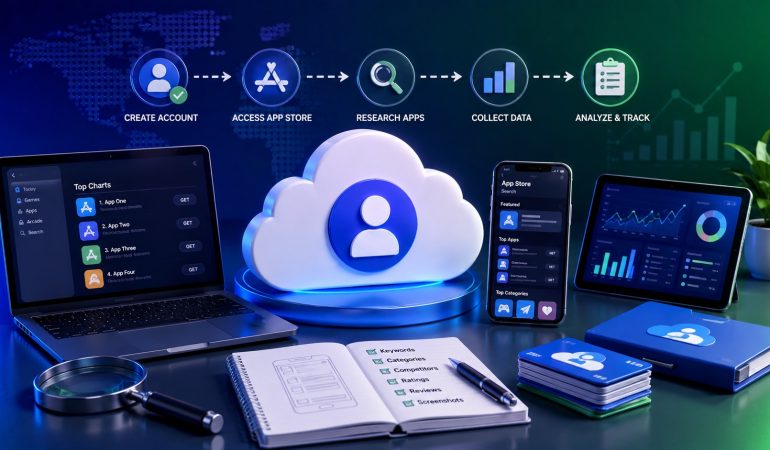
A well-run competitive research workflow typically follows a repeatable cycle:
- Baseline capture — Document the competitor’s current listing, keywords, pricing, and ranking position using a dedicated, untouched account
- Scheduled re-checks — Revisit the same metrics weekly or monthly using the same account to preserve continuity
- Change logging — Record any shifts in screenshots, descriptions, pricing, or ranking position
- Cross-reference with category trends — Compare changes against broader category movement to separate competitor-specific strategy shifts from industry-wide trends
Importantly, using the same account consistently for this cycle matters more than most researchers realize. If you switch accounts between checks, however, you introduce variability that makes it harder to tell whether a ranking change is real or just an artifact of a different account’s personalization profile.
App Store A/B Testing Observation
Many developers run App Store Connect’s built-in product page optimization tests, showing different screenshots or icons to different user segments. Researchers trying to observe these tests in the wild — to understand what a competitor is experimenting with — need multiple clean accounts to catch different test variants, since Apple’s testing framework splits traffic across account-level buckets.
🚀 Quick SummaryCompetitive ASO research depends on consistency. A dedicated account checked on a regular cadence produces far more trustworthy trend data than ad hoc checks from rotating or shared accounts.
🗂️ Structuring Research Accounts by Function
Just like any operational asset, iCloud accounts for app store research perform best when organized around a clear naming and purpose structure. Without this, research teams end up with a pile of generic accounts that nobody can confidently attribute to a specific research stream.
Function-Based Naming Convention
Most research teams find it effective to name accounts after their specific research function rather than a generic label:
aso-us-keyword-tracking@domain.comaso-uk-pricing-research@domain.comcompetitor-baseline-fitness-category@domain.comaso-de-localization-audit@domain.com
Separating Research Accounts From Development Accounts
It’s worth noting that research accounts serve a different purpose than the test accounts used in app development workflows like TestFlight beta distribution. Mixing the two — using a TestFlight beta tester account to also run competitor research — muddies both data sets. Keep research accounts entirely separate from any account involved in your own app’s development or QA pipeline.
| Account Type | Primary Purpose | Should Overlap With Research Accounts? |
|---|---|---|
| ASO Research Account | Competitor and market analysis | — |
| TestFlight Beta Account | Internal app testing and QA | No |
| Personal Apple ID | Individual device use | No |
| Regional Pricing Account | Localized pricing verification | Can pair with ASO research if same region |
Sourcing a batch of aged iCloud accounts upfront, rather than creating them one at a time as needs arise, allows research teams to build out this structure deliberately instead of reactively patching gaps mid-project.
🛠️ Setup Best Practices
Once you’ve defined your research account structure, the actual setup process determines whether the data you collect will hold up over time. Here’s what experienced ASO researchers prioritize:
1. Lock Region Settings at Creation
Set the account’s country/region during initial setup and avoid changing it later. Apple ties significant App Store behavior to this setting, and switching it mid-research can reset personalization in ways that disrupt longitudinal tracking.
2. Avoid Cross-Contaminating Search History
Each account should be used for a narrow, defined research scope. An account used to research fitness apps one week and finance apps the next will develop a blended personalization profile that makes neither data set fully reliable.
3. Document Account-to-Project Mapping
Maintain a simple internal reference — even a basic spreadsheet — mapping each account to its research function, region, and creation date. This becomes essential when research spans multiple months and team members.
4. Secure Recovery Access at the Team Level
Just as with business device accounts, research accounts should have 2FA recovery tied to a team-controlled method — not a single researcher’s personal device — to avoid losing access to months of accumulated research continuity if that person is unavailable.
Apple’s own two-factor authentication documentation outlines how recovery methods are managed, which is worth reviewing when setting up team-controlled recovery for multiple accounts.
⚠️ Common Research Pitfalls to Avoid
Even well-resourced research teams run into avoidable mistakes when working with iCloud accounts for app store research. Here are the ones that show up most often:
| Mistake | Best Practice |
|---|---|
| Using one account for every research task | Dedicate accounts to specific functions or regions to keep data clean |
| Switching region settings mid-project | Lock region at creation and create a new account if a different market is needed |
| No documentation of account purpose | Maintain a simple log mapping each account to its research scope |
| Tying 2FA recovery to one researcher’s device | Use team-controlled recovery methods accessible to more than one person |
| Mixing personal browsing with research activity | Keep research accounts strictly limited to their defined research scope |
The Hidden Cost of “Good Enough” Research Accounts
It’s tempting to treat App Store research as low-stakes enough to run from whatever account is convenient. But inconsistent or contaminated data has real downstream costs — a flawed competitive analysis can lead a product team to misjudge a competitor’s pricing strategy, miscalculate keyword opportunity, or miss a regional expansion signal entirely. The relatively small effort of maintaining dedicated, well-structured accounts pays for itself the first time it prevents a strategic misstep.
❓ Frequently Asked Questions
1. Why can’t I just use my personal Apple ID for app store research?
Your personal Apple ID carries a personalization history — past searches, downloads, and region settings — that skews search results and recommendations. This makes it unreliable for objective research like competitor benchmarking or keyword ranking checks.
2. How many iCloud accounts for app store research do I actually need?
It depends on scope. A solo researcher tracking a single category in one region might only need 2–3 accounts. A team running multi-region ASO research across several product categories could reasonably need 10 or more, each tied to a specific function.
3. Can one account be used for both US and international research?
Not effectively. App Store storefronts are tied to an account’s registered region, so a single account will only ever show you data for the region it’s configured to. Separate accounts are needed for separate markets.
4. Do I need upgraded iCloud storage for research accounts?
Usually not. Research accounts typically don’t need much storage space, so the free tier usually works fine, unless you’re using the account to download and keep multiple apps for extended testing.
5. How often should I re-check competitor rankings?
This depends on how competitive your category is. Fast-moving categories (games, social apps) often warrant weekly checks, while more stable categories (utilities, productivity) may only need monthly reviews.
6. Is it better to buy pre-verified accounts or create new ones manually?
Manually creating accounts one at a time involves phone verification and setup friction for each one, which doesn’t scale well for research teams needing several accounts at once. Sourcing aged iCloud accounts from a reliable provider saves significant setup time while still allowing full configuration control afterward.
7. Can app store research accounts be shared across a team?
Yes, but use a secure password manager with controlled access instead of passing credentials around informally – this way, you avoid losing track of who has access or accidentally disrupting an account’s research continuity.
8. What’s the difference between ASO tools and using dedicated iCloud accounts directly?
However, ASO platforms aggregate ranking and keyword data at scale, but they don’t always replicate the exact experience a real user in a specific region sees. As a result, dedicated iCloud accounts for app store research let you verify findings firsthand, which is especially useful for visual and pricing audits that automated tools can miss.
✅ Key Takeaways
- Personal Apple IDs introduce personalization bias that compromises App Store research accuracy
- Dedicated, isolated accounts produce cleaner, more trustworthy competitive and keyword data
- Regional research requires region-specific accounts, since account settings determine your storefront.
- Consistent use of the same account over time improves the reliability of trend tracking
- Function-based naming conventions prevent confusion as account volume grows
- Research accounts should remain separate from development/QA accounts like TestFlight testers
- Team-controlled 2FA recovery prevents loss of access when individual researchers are unavailable
- Documenting account-to-project mapping is essential for long-term research continuity
- Sourcing accounts in bulk saves significant setup time compared to manual one-by-one creation
- Clean account hygiene directly impacts the strategic decisions built on top of that research
🏁 Conclusion
Ultimately, reliable App Store research depends on more than good analysis skills — it also depends on the quality and structure of the accounts behind that research. In fact, iCloud accounts for app store research give competitive analysts, ASO specialists, and product teams the clean, unbiased view of the App Store that personalized personal accounts simply can’t provide. Furthermore, from regional pricing audits to long-term competitor tracking, a well-structured set of dedicated accounts turns inconsistent, noisy observations into research you can actually build strategy on.
In short, whether you’re auditing a single competitor or building out a full multi-region research matrix, the principle stays the same: isolate your accounts by function, document your structure, and protect the continuity of your data.
That discipline is what separates reliable ASO insight from guesswork.